
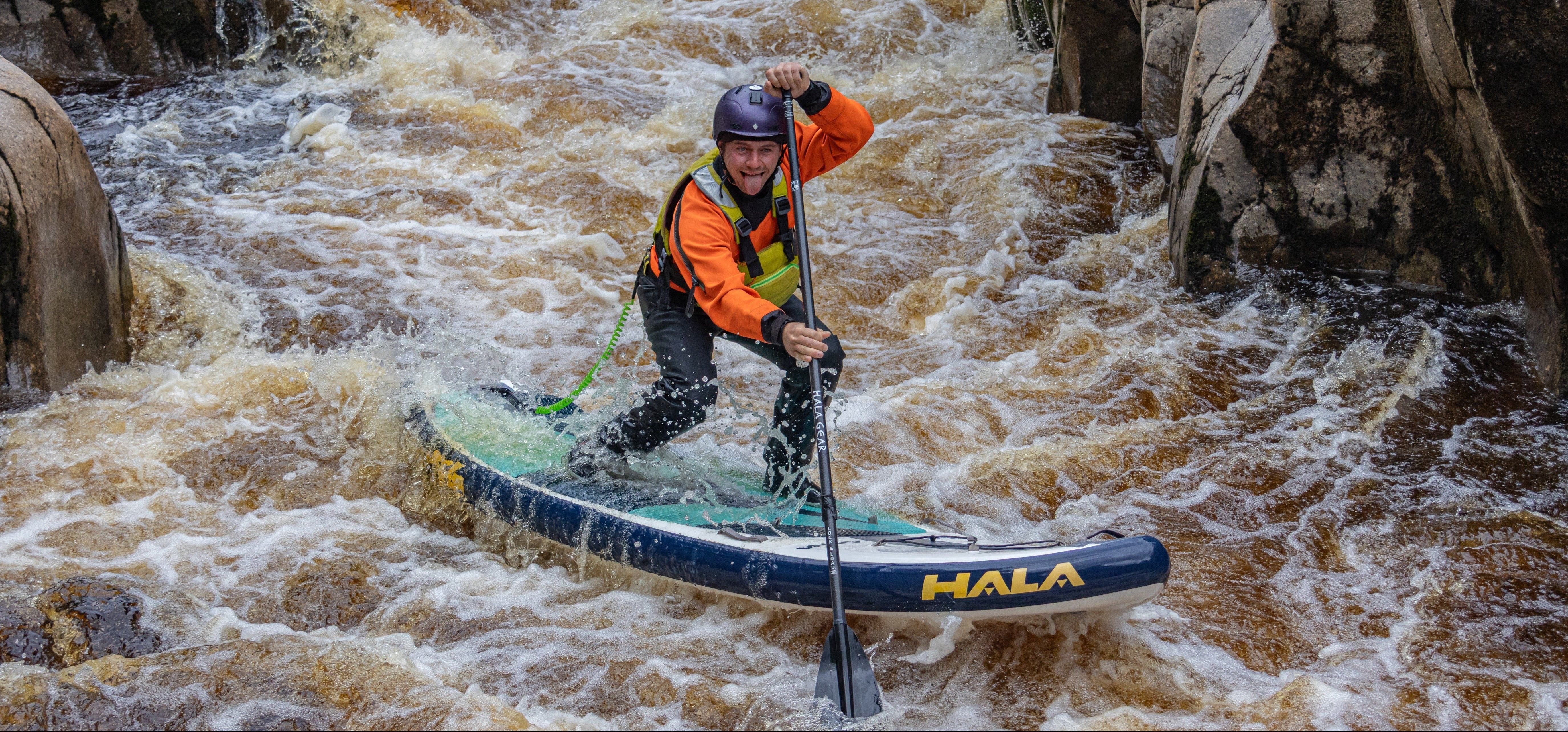
The Best Inflatable Whitewater SUP Boards: A Guide From the People Who Built the Category
We have been building inflatable whitewater SUPs since 2011 — longer than any other brand in the sport. The dimensions we settled on for the first Atcha — 9 feet 6 inches long and 36 inches wide — became the template the entire industry eventually adopted. The fin system we invented and patented in 2015, the StompBox, is still the most distinctive feature in whitewater SUP. Over 50 prototypes and thousands of hours on rivers across Colorado and beyond went into proving these shapes.
That history matters here. When we tell you which board is best for you, we are drawing on 14 years of iteration on the same fundamental question: what does an inflatable board need to do in serious moving water?
Quick Answer: Best Whitewater SUP by Paddler Type
| Board | Best For | Class Rating | Type |
|---|---|---|---|
| Atcha 96 | Technical whitewater, big water, learning river SUP | Class III-IV | Whitewater-specific |
| Atcha 86 | River surfing, playful performance, tight lines | Class III-IV | Whitewater-specific |
| Rado | Expedition trips, river and lake crossover, fishing | Class I-III | All-water crossover |
| Radito | Compact crossover, smaller paddlers, versatility | Class I-III | All-water crossover |
Know roughly what you need? Take our board quiz for a personalized recommendation — or read on for the full breakdown.
What Makes a Great Whitewater SUP
Before comparing boards, here are the three things that separate good river boards from everything else.
River Rocker
River rocker is the upward curve of the board from nose to tail. More rocker lifts the nose over waves instead of punching into them — critical in a wave train or over a drop. Not enough rocker and the board submarines; too much and you lose tracking between features. Every board in this guide is shaped specifically for its role in moving water. The whitewater-specific Atcha boards have aggressive performance rocker tuned for Class III-IV and above. The all-water Rado and Radito have a more moderate river rocker profile that handles the full spectrum from mellow floats to Class III without sacrificing flatwater efficiency.
The Fin System
Fixed fins in rocky rivers are a liability. They catch rocks, stop boards dead, and send paddlers flying. Getting the fin system right took years of iteration. Hala was the first to run a quad fin configuration on inflatable whitewater SUPs and kept pushing: quad, then quad+1, then quad fins paired with the original StompBox 1.0, then StompBox 2.0. The current setup — two removable side fins plus the StompBox 2.5 retractable center fin — is the result of that full arc of development. Side fins deliver surf-style directional control; the StompBox uses active downward spring pressure to stay fully deployed at all times and deflects cleanly off rocks on contact, snapping back to full deployment instantly. No manual operation. No fin swap mid-rapid. Every other manufacturer has followed some version of this path. Hala built the road.
Thickness and Volume
Hala championed 6-inch-thick inflatable boards when conventional wisdom said thinner was better. Six inches of thickness means rigidity in moving water, a platform for powerful strokes, and confidence when a thinner board would flex out from under you at the worst moment. Independent testing at Inflatable Boarder recorded just 1.46 inches of bend on the Atcha 96 in static flex testing — below average across all whitewater SUPs they have tested.
Two Types of Whitewater SUP: Know Which One You Need
Whitewater-Specific Boards
The Charge Series — the Atcha 96 and Atcha 86 — are designed to maximize performance in technical moving water. High river rocker profiles, surf-inspired outlines, and shapes tuned for rapids, waves, and river features. Built for Class III-IV and beyond. On flatwater they paddle fine, but everything about their design is optimized for the river. Both boards love lakes just as much when you are off the river — the Charge Series does not trap you.
All-Water Crossover Boards
The Adventure Series — the Rado and Radito — are built to perform on rivers and flatwater without compromising either. You can run Class I-III in the morning, fish a calm section in the afternoon, and paddle a mountain lake the next day. They carry gear, rig for overnight trips, and handle expedition distances in a way the Atcha boards are not designed for.
The all-water boards are often the smarter first purchase. Especially for paddlers who are on more than one type of water — the Rado or Radito goes on every outing, not just river days. That versatility makes them one of the best investments in inflatable SUP.
Board Reviews
Hala Atcha 96: The Benchmark

The board that defined the category. The first Atcha sold in 2013, and its 9 foot 6 by 36 inch dimensions became the industry template — measurements that competitors eventually adopted because they were simply correct. Over a decade of refinement has made the current version the sharpest yet.
After extensive field testing, Inflatable Boarder was unambiguous: "With well over a decade of incremental shaping and material improvements, the Atcha 96 is quite possibly the pinnacle of design for intense whitewater paddling."
The rocker profile follows a continuous curve from nose to tail, keeping the board in constant dynamic balance as you shift weight through rapids. On stiffness: at 18 PSI with welded construction, it recorded just 1.46 inches of bend in static flex testing — below average across all whitewater SUPs tested.
As founder Peter Hall puts it: "The Atcha came from exhaustive testing and prototyping. We approached the design from brand new angles with the goal of creating the surfiest downriver whitewater machine that has ever been made."
Best for: Paddlers making the jump to technical river SUP, big-water runs on powerful rivers, anyone who wants the board the sport was built around.
Dimensions: 9'6" x 36" x 6" | Capacity: 275 lbs | Weight: 27.5 lbs
Hala Atcha 86: The River Party Machine

Shorter, lower in volume, and designed for paddlers who want precise control in river holes, tight lines, and dynamic features. The 86 evolved from years of internal development on smaller, more aggressive shapes — boards that were technically advanced before most paddlers had the skill to ride them.
Paddling Magazine named the Atcha 86 their Best Whitewater SUP for 2026, tested head-to-head against every board in the category by Joe Potoczak, a former US Wildwater Team member. Their bottom line: "The Hala Atcha 86 brings street-style skateboarding to the whitewater SUP scene."
The trade-off is technique. This board rewards skill and punishes hesitation. If you're already comfortable on moving water and want to push your paddling, the 86 is your board. If you're newer to river SUP, start with the 96 and work up.
Best for: Experienced river SUP paddlers, river surfing, precise technical lines, tight features and holes.
Dimensions: 8'6" x 34" x 6" | Capacity: 250 lbs
Hala Rado: The All-Water Expedition Board

The Rado answers the question every versatile paddler eventually asks: what if I want one board for rivers, lakes, multi-day trips, and fishing? At 10'10" x 35" x 6", it is Hala's largest board — with expedition-ready rigging points, carrying capacity for overnight gear, and genuine StompBox performance in Class I-III whitewater.
The full-rocker profile and narrow side cut give the Rado more river performance than you would expect from a board this versatile. The longer waterline keeps it fast and efficient on flatwater. And because it is built on the same StompBox 2.5 DNA as the Atcha, it deflects off rocks in shallow river sections and snaps back to full fin deployment instantly.
The Rado is also Hala's top pick for SUP fishing. Rig it with a mini cooler and an attached rod holder and you have everything you need on rivers, reservoirs, and mountain lakes. The rigging points front and back handle coolers, dry bags, and gear for multi-day floats. Hoss and Rado both love a laid-back fishing day on calm water just as much as they love a river run — the Charge boards enjoy that too when the day calls for it.
Best for: All-water paddlers, expedition and multi-day river trips, SUP fishing, paddlers who want one board for every situation.
Dimensions: 10'10" x 35" x 6"
Hala Radito: Compact Expedition Performance

The Radito is the Rado scaled for smaller paddlers, lighter loads, and situations where a compact board handles better — tighter rivers, technical eddy work, and hard-to-reach spots where the Rado's length becomes a liability. It carries the same StompBox fin system, the same river-to-flatwater versatility, and the same expedition capability in a nimbler package.
Inspired by the Team Rado, the Radito's streamlined outline is narrower through the hips and shoulders — bringing speed, maneuverability, and a responsive feel that makes it ideal for technical river sections and fishing spots the bigger board cannot access.
Best for: Smaller paddlers, compact versatility, narrow rivers, SUP fishing in tight spots.
Head-to-Head: All Four Boards
| Atcha 96 | Atcha 86 | Rado | Radito | |
|---|---|---|---|---|
| Type | Whitewater-specific | Whitewater-specific | All-water crossover | All-water crossover |
| Best class | III-IV | III-IV | I-III | I-III |
| Flatwater | Good | Good | Excellent | Excellent |
| River surfing | Great | Best | Capable | Capable |
| Expedition trips | No | No | Yes | Yes |
| SUP fishing | No | No | Top pick | Great |
| Skill level | Intermediate+ | Advanced | All levels | All levels |
Which Board Is Right for You?
- Mostly flatwater with occasional rivers? Go Rado or Radito. You will use it more and perform well on both surfaces.
- Charging Class III-IV rapids? Go Atcha 96 — the benchmark for technical whitewater and the right starting point for most river-focused paddlers.
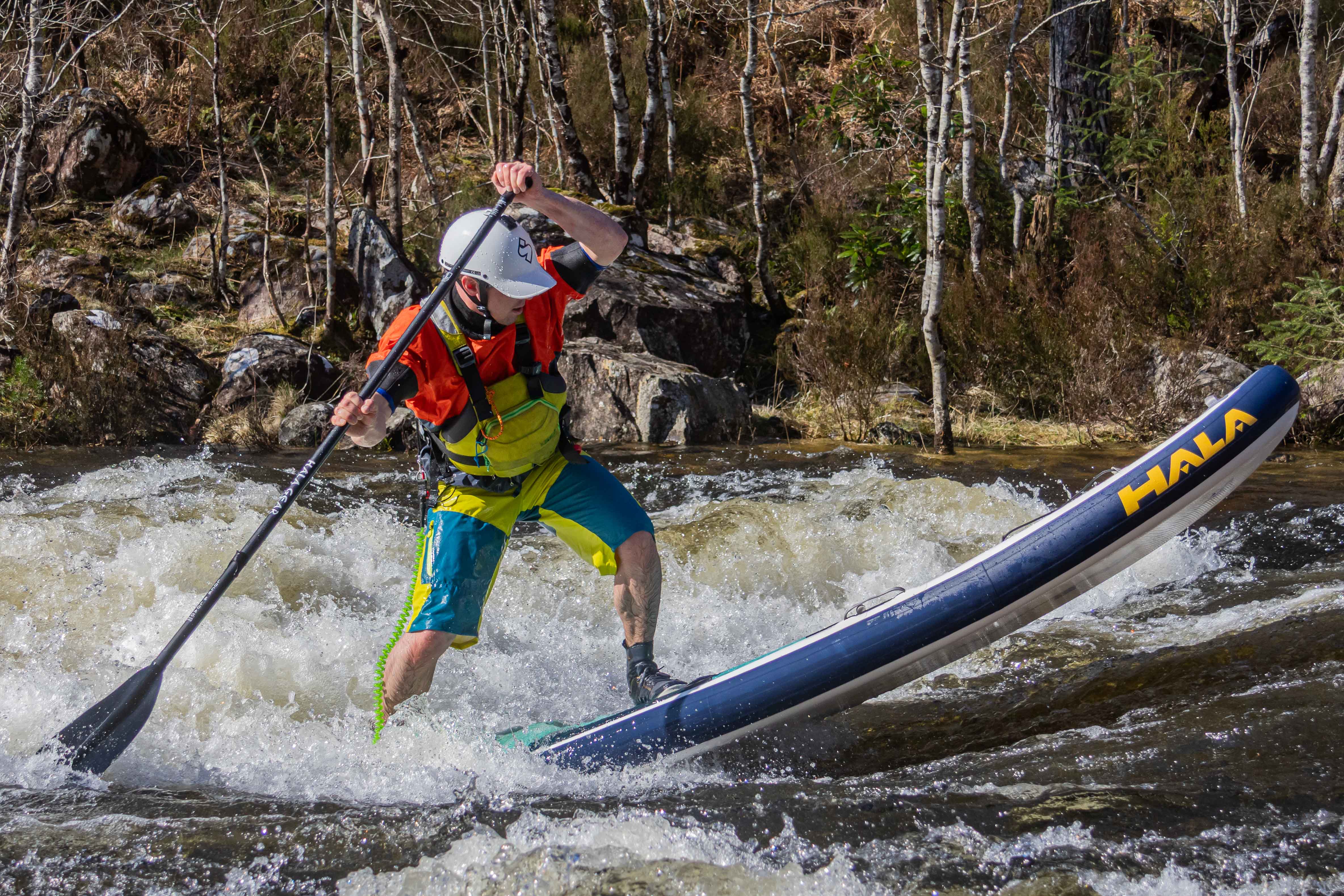
- Already experienced on rivers, want to surf features? Go Atcha 86.
- Multi-day trips, fishing, or need one board for everything? The Rado. Expedition-ready, river-capable, flatwater-efficient.
- Smaller paddler or tighter rivers? Radito over Rado.
Still not sure? Take our board quiz for a recommendation based on where you paddle and what you want from your board. Or reach out to the team — we paddle all of these on Colorado's Yampa, Green, and Arkansas rivers and can point you in the right direction.
Frequently Asked Questions
What is the best whitewater SUP for beginners?
For most paddlers just starting river SUP, the Atcha 96 is the right first dedicated whitewater board. Its larger volume and 36-inch width give you more stability than the 86 while still being shaped for real moving water. If you're new to SUP entirely but want to do rivers as well as flatwater, the Rado is actually the smarter first purchase — all-water performance with full StompBox capability, so you can develop river skills before committing to a whitewater-only shape.
What class rapids can you SUP?
Experienced paddlers run Class IV and occasional Class V on SUPs, though most whitewater SUP happens in the Class II-IV range. The Atcha 96 and 86 are built for Class III-IV and beyond. The Rado and Radito are solid on Class I-III. Your skill level matters more than the board — a technically proficient paddler on an Atcha 96 can handle water that would be dangerous for a beginner on any board.
Is whitewater SUP hard to learn?
River SUP is harder than flatwater but very learnable with the right foundation. Most paddlers start by building flatwater balance and basic stroke mechanics first, then progress to easy Class I-II moving water. The stability of modern inflatable whitewater boards — especially the Atcha 96 at 36 inches wide — makes the transition accessible. What the sport demands is reading water: understanding where current pushes and how to use it. That skill comes with time on the river.
What is river rocker on a SUP, and why does it matter?
River rocker is the upward curve of the board from the centerline toward the nose and tail. High river rocker lifts the nose over wave crests and through the face of hydraulics rather than diving under them — critical on Class III and above where a flat-nosed board would get pushed underwater in the same features. All Hala whitewater boards are shaped with river-specific rocker profiles tuned for their role: the Atcha boards have aggressive performance rocker, the Rado and Radito have a flatter, more versatile profile that still has more river rocker than any flatwater board.
Do I need a special paddle for whitewater SUP?
Not a completely different paddle, but sizing matters. For whitewater, most paddlers drop their paddle length 3-6 inches shorter than their flatwater length — a lower blade entry helps you brace and stay lower in rough water. See our paddle sizing guide for the whitewater elbow method.
Can a regular inflatable SUP be used in whitewater?
No. The fin system alone disqualifies most flatwater inflatables from serious river use — a large center fin dragging over rocks will wreck the board and throw the paddler. Beyond the fin, flatwater boards lack the rocker profile and width distribution needed for moving water stability. The boards in this guide are built specifically for rivers. If you want to run Class I-II with the occasional easy rapid, a versatile all-arounder like the Hoss can manage it with a fin swap, but purpose-built river boards start with the Rado for the StompBox fin system alone.
Why Hala
Hala Gear was founded in 2011 in Steamboat Springs, Colorado, on the banks of the Yampa River. The first Hala board people thought was crazy: 6 inches thick and 35 inches wide, built to hold its own in moving water when everything else was designed for flatwater. That stability-first philosophy — setting paddlers up to succeed before pushing their limits — still drives every board we build.
The 9'6" x 36" dimensions we developed for the first Atcha in 2013 became the industry template. The fin evolution tells the same story: Hala introduced the first quad fin configuration in inflatable whitewater SUP, then kept iterating — arriving at the current two side fins plus StompBox. The right combination took years to prove. The industry has followed every step.
Independent validation keeps coming. Paddling Magazine named the Atcha 86 Best Whitewater SUP for 2026 — tested head-to-head against every board in the category by a former US Wildwater Team member. Inflatable Boarder awarded the Atcha 96 Editor's Choice. Two independent publications. Same conclusion.
"Small differences make huge differences — shaping an inflatable fabric and predicting how it will react to whitewater is an art that we are continuing to perfect." — Peter Hall, Founder, Hala Gear
Every Hala board ships with welded construction and a 5-year warranty.

Leave a comment
This site is protected by hCaptcha and the hCaptcha Privacy Policy and Terms of Service apply.